Princes ELC

PRINCE ALFRED COLLEGE EARLY LEARNING CENTRE

An environment designed to foster creativity, provoke questions, provide challenges and celebrate the achievements of young children. We foster the development of integrity, curiosity, confidence, compassion and Christian principles.We encourage relationships of shared responsibility and mutual respect. We believe in fun and the joy and importance of childhood. We ensure an environment filled with a sense of humour, love of play and exploration, and a sense of community.

Friday, June 2, 2017

Cooper

Dear Cooper families and friends,

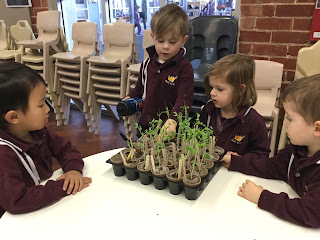
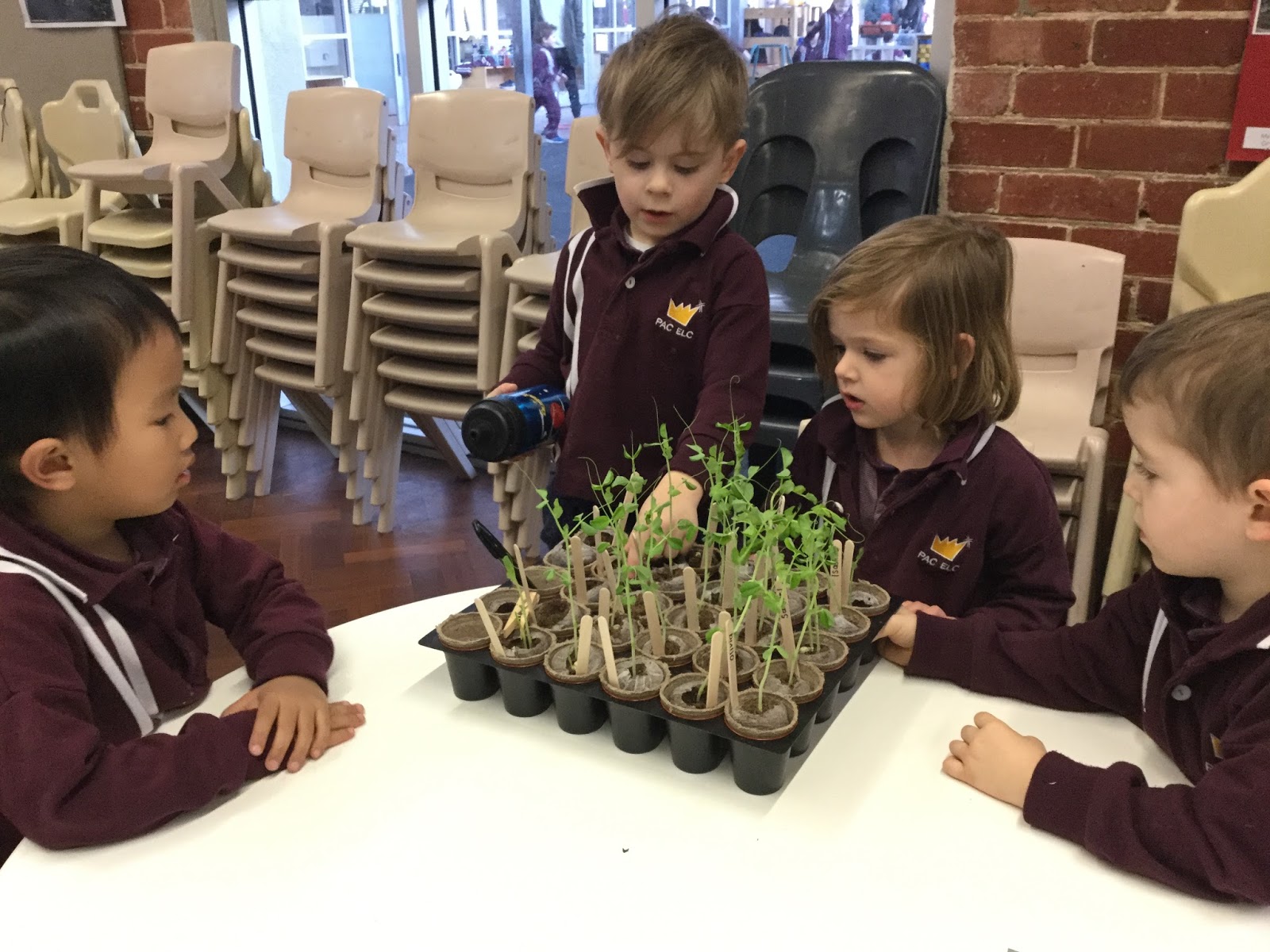
On Monday when the children entered the classroom, many of them noticed that something special had happened… our bean stalks had grown! The bean stalks hadn’t just grown a little bit; they were grown very tall. Across the week, the children have conversations around who’s beans were the tallest and who’s beans were the shortest. We were all bursting with excitement to find out who had the very tallest plant, so we decided to measure our beans. We each measured our individual beans using a ruler, and recorded our information in a whole class chart. Isaac C’s beanstalk measured at a whopping 20cm tall and some plants haven’t yet emerged from the soil. The children through this experience the children used their knowledge of number to identify how tall their plant had grown. Through this experience the children are developing an understanding that numbers are used for many different purposes in their world.

Sebastian A  – Mines little. Its only 5 centimetres high.  You have to put the ruler at the bottom so you can measure it.
Ned – Mine is so tall, it goes all the way to 18.
Olivia – Mine is that number. 1, 2, 3, 4, 5, 6, 7, 8, 9, 10, 11, 12, 13, 14, 15 ,16. 16 tall!
Giuliana – Its growing, like this tall. It’s a small plant.

This weeks ‘show and tell’ has been particularly exciting this week as the children love gardening, investigating and making new discoveries about the life cycle of a plant. We were able to replant many of the cuttings that were brought in for show and tell this week and we will plant the rest of the plants next week.

Lotti – We need to dig in the dirt and then put the Squirty African Plant in. Then we have to water it.
Grace – Can I help plant the plant? I'll dig the soil.

We hope that you have a lovely weekend.

Love Miss Gilbert and Mr Richards 


Mid-Year Parent Information - RSVP's due!

If you have received an invitation to join us for the Mid-Year Parent Information Evening on Monday 19 June at 6.30-8.00pm - we need your RSVP's.

This evening is for those families who are joining us for the mid-year intake and for those children moving classrooms eg Wilkins, Langley, Cooper and Edgerley. 

Please email us on elcadmin@pac.edu.au to advise. 

Thank you 

Melanie and Mandy 

Wilkins

Dear Wilkins families and friends,

We have engaged our senses with the beautiful Autumn leaves this week, exploring them with our bare feet! The children have loved jumping and sliding, scrunching and crunching the leaves with their feet and toes. 

We have continued to explore fine motor control and coordination this week, manipulating a range of different types of scissors to cut the grass and different patterns on paper. We have also been using hammers to develop our eye hand coordination, hitting and whacking the wooden block puzzles. 

The office area continues to be an area of interest, with the children practicing their social skills as they share resources and negotiate roles in their play. We have extended our role play in to the play dough corner, creating different foods and drinks as well as a range of different shapes.

Stay warm in this freezing weather! We look forward to seeing you all next week.

Best wishes,


Ellen, Courtenay, Melissa, Chelsea and Jess


Article: Getting ready for school

With many of the 4's moving towards starting school I thought some tips might come in handy. Starting school can be a big change for your child – and a big change in your family life too. Although it’s an exciting time, it’s normal to feel a little worried or sad about it. Keeping your worries to yourself and letting your child know that you think he’ll go well at school helps your child feel positive too.

Here are tips to help you and your child feel ready for starting school.
Getting familiar with school
·         If your child is at a preschool with a school transition program, try to make sure your child is at preschool on the days the children visit ‘big school’. If your child isn’t at preschool, visit the school yourselves, or see if the school runs its own transition day. This helps your child get familiar with the grounds, the classroom, the toilets, the bubblers or drinking fountains, the noise of the big kids and so on.
·         Meet your child’s teacher together and give your child an idea of how many children will be in the class. Let your child know that teachers are there to help, and she can ask for help any time.
·         Explain the basic school rules, like putting up your hand, asking before going to the toilet, listening quietly when you need to, and doing what the teacher asks.
·         Make sure your child knows where you’ll be picking him/her up.
Practical preparations at home
·         Get your child to try on the uniform and shoes before the first day, just to make sure everything fits. It’s a good idea to have your child wear new school shoes for a few days before school starts to wear them in.
·         Make sure your child has all the extras – bag, hat, art smock, library bag and so on.
·         Have a practice run with the lunch box to make sure your child can take off the lid. You could even do this before buying the box. 
Feelings
·         Try to organise playdates with other children before the first day of school. It’ll help if your child knows another child from class before school starts. 
·         Give your child lots of love and support. Be excited and enthusiastic about your child starting school. This sends your child the positive message that school is exciting and that they’ll cope and have fun.
·         Think about how you’ll manage your feelings on the first day. Even if you’re feeling sad or worried, it can help to keep these feelings from your child. Instead, try to see your child off with a happy, confident goodbye – and plan something nice for yourself too, like coffee with a friend.
·         Read a children’s book about starting school with your child. Reading books about school together can help you talk with your child about his feelings. You could try Starting school by Janet and Allen Ahlberg, or Starting school by Jane Godwin and Anna Walker.

Starting school: the early weeks

Your child is likely to need a lot of support when school starts. There are some simple things you can do to help these first few weeks go smoothly:
·         Try to drop off your child at school before the bell goes in the morning. Also pick your child up on time. If you’re late it could make your child feel very anxious. 
·         Try to make after-school time a bit special, with a snack and time for the two of you to chat.
·         Be patient if your child wants to blurt out every little detail about school, or clams up completely. You could try saying something like, ‘Tell me one good thing about your day’, rather than asking lots of questions.
·         Try to be flexible with snacks and meals. Your child will probably be very hungry after school. If you give them a small, healthy snack straight after school, it’ll help to keep them going until dinner.
·         Don’t expect too much academic progress too soon. If your child is happy and seems to be enjoying school, that’s a real achievement. The rest will come later.
·         Remember that it’s normal for children to play with lots of different children, and even to play on their own sometimes. It takes a while before they settle into a group of friends.
·         Your child is likely to be very tired after school for the first few weeks. It's a good idea to limit after-school activities for the first term and stick to a bedtime routine if you can.

Emma McKenzie
Teacher - Edgerley Room

Wellbeing Facilitator
Edgerley

Dear Parents,

It's been another busy week in the Edgerley Room. Our investigations into habitats have continued with a move from our arctic environment to the sea. In our discussions we identified the various habitats that we knew.

Rory - Grasslands for lions 
Aston - Where do panda’s live? They eat gumnuts, I mean bamboo, in bamboo places they live  
Rory - It’s woods!  
Archie - And camels live in deserts  
Will G - And people live in houses 
Mrs Bishop - What are houses called when they all go together? 
Alex - It’s a town  
Will L - And there is mountains  
Archie - And the world is a habitat 

As we recorded these we decided to draw a circle around all of our habitats to represent the world, as all of them are found in the world. The children were keen to list the types of animals that could be found in the various habitats but the teachers were keen for the children to reflect more deeply about what animals found in their habitats that made them want to stay there. Very quickly the children were able to identify food, water and air as things they needed in their environment of the city of Adelaide. 

Will P - We need toilets  
Angus - To do wee and poo!   
Mrs Bishop -What does a toilet do for us?  
Archie - Flush! It makes it clean!
Mrs Bishop - Yes, we like a clean habitat 
Aston - And we need a car  
Mrs Bishop - Do we? Do we need a car or do we want a car?  
Aston - We need it so we don’t have to walk everywhere  
Mrs Bishop - Will A’s Dad doesn’t’ have a car? Do we need one?  

We had a special "What's the Buzz" lesson with Mrs McKenzie on Tuesday and learnt to identify the difference between opinions and facts. As we began to understand the difference we identified that in friendships we are able to have different opinions to one another and still be good friends. We also agreed that when people have a different opinion we need to respect their opinion and not get angry, frustrated or try to change it. After all, wouldn't it be boring if we were all the same!

Best wishes,

Emma, Mel and Cris


Chapple

As part of our inquiry into Push and Pull we read the “Lighthouse Keeper’s Lunch.” We made our own pulley system and also discovered that seagulls don’t like mustard. We got some mustard from the kitchen and the children smelt it. They understood why the seagulls didn’t eat the food and didn’t want to eat it either!

We continued our work into emotions and had a go at role play. The children were able to show all types of emotions and then ask questions about how they were feeling and how we could change how they are feeling. Liliana had a very frightening angry face and Jonas did a great job of making her smile again.

We have looked at symbols and in preparation for World Environment Day we looked at the sign for recycling. We used our mark making table to write our own signs and symbols.

We also have been developing our gross motor skills in PE, the children really enjoyed the new hitting tees.


Chapple Room


Mead

Dear Mead Room families,

We have continued to investigate the bones in the human body this week. After studying X-rays on the light table, we decided to make our very own x-rays! We traced our hands on black paper and glued on cotton buds to represent the bones in our hands. 

Vivienne - 1, 2, 3, 4, 5! Five fingers!
Jack - What are these? Are they our bones?
Ronnie - They're phalanges!

Did you know, the bones in our fingers are called "phalanges"? 

Monday 5th of June is World Environment Day, our focus is sustainability. This week we have been speaking about recycling and how we recycle in the ELC, as well as at home. Along with the Mattingley class, we are conducting a science experiment to see what does and doesn't break down in our environment. We have filled 6 jars with dirt and added organic and inorganic items such as sandwiches, food scraps, leaves, paper towel rolls, glad wrap and alfoil. Over the week we have been watching what happens inside our jars. We can't wait to see the final result and what happens inside our jars.

Scout - Dirty nappies go in the rubbish!
Jack - Daddy puts the bins out at my house.
Teddy -  Paper and cans go in the recycling, my green bins are full of weeds!
Anwen - Yucky things go in the bin.  

Have a great weekend, 
Miss Boler 


Langley

Dear Langley Families and Friends, 

This week we have been exploring colours. The children have thoroughly enjoyed exploring colours whilst sorting the coloured bugs, creating coloured dripper paintings and reading stories during our small and large group times. It has been great to see the children’s knowledge of colours develop over a few short weeks. 

We have also been welcoming some new friends and further extending our friendships. Our new classroom set up has provided the children with some great areas to work together and create complex pretend play scenarios. 

Our book shelf has also been very popular this week, with the majority of the class reading stories to themselves and also to their peers. Some of our favourites have been ‘Owl Babies’ and the “Hairy Maclary’ series. 

Some of the Langley Class will be moving up to the Cooper Room in the middle of the year. We will be conducting transitions for the children over the coming weeks to ensure that they get the best start possible. 

We hope that you have a lovely restful weekend and look forward to seeing you next week. 

From 

Ms Kathy, Ms Amelia, Miss Nicole, Miss Tayla and Miss Georgia


Angwin

Dear Parents and Friends,

Angwin has been a hive of activity this week as we have pursued our inquiries and developed our skills further. Map making continues to feature as children have made maps of the playground and as we have shown the Cooper class our map of where the rainbow birds are.

Block building and creating co-operative building projects have featured as wonderful co-operative constructions have included much problem solving, negotiation and creativity.

We have continued to explore mark making through our exploration of Aboriginal symbols in the coloured sand and at the painting easels.

The children have been working to consolidate the experiences we enjoyed in our zoo trip, by creating their own small world zoos, illustrating reflections from the visit and adding comments to our class book.

The children have also enjoyed following a procedure to create their own traffic light biscuits.. independently spreading the butter, adding the toppings and then enjoying the eating!

Purposeful writing has been in action as the children have made signs for our veggie patch and created their own signs after our investigations into different signs around us that keep us safe…
We have talked about why we need to have signs….

Ashton -  Speed limits have numbers and writing. They tell the cars how fast they can go
Edward - Bus stops tell us where to wait
Paxton - Road signs tell us what to do
Chloe - They tell people what they have to do
Billy - The signs tell us to stop and go
Ryan - If there were no signs people might crash. Signs keep people safe.
Oscar - If we look at the signs we can be safe.
Roy - Signs are everywhere in Australia and in China too
Mrs Cooper - Did you know that there are signs in every country and even if you can’t speak Chinese or Italian, you can still know what the sign is about… if there are numbers, pictures and symbols

Have a wonderful weekend.
Kind regards,
Pip and Coney


Mattingley

Dear Mattingley families and friends,

We have had some very busy construction workers hard at work building houses out of different materials this week, continuing on from their exploration of the 'The three little pigs'. The focus of their constructions were that in the story the brick house was the strongest. Testing out this theory the children would try to blow down their constructions once they were finished to see just how strong they were. This lead to lots of laughter and shrieks of excitement as buildings toppled over. 

Mack - This is the big bad wolf's house. Don't blow it down yet Hudo  
Hudson - Oh no! It fell down 
Phoebe - We making a big brick house
Didier - My house is strong! We made it out of bricks. It won't blow down 
Mack - Maybe if it rains the straw house will was away 
Ari - My house is bigger and bigger. Ahhh! It fell down 

We will continue this exploration over the weeks to come, working with a range of different materials. We will take a closer look at how houses are built and the different materials that they are built with. If you have any photos of your house that you would like to share we would love to add them to our exploration. 

As part of our investigation into sustainability the Mead and Mattingley children have been thinking about  where the rubbish they produce at home and at ELC goes when it is put into the bin, and how they would feel if it ended up in their Outdoor Learning Environment at ELC. 

Hudson - Very cross 
Dylan - Very yucky 
Phoenix - It needs to go to the dump 

To explore the effect that rubbish has on our environment we have set up an experiment. In glass jars we have added food scraps, a sandwich, glad wrap, alfoil and leaves to soil to see if they will break down or stay the same. The children have begun to hypothesise what they think might happen over time. We look forward to observing the glass jars over the next week to see what changes occur, and sharing our findings with the rest of the ELC on World Environment Day next Monday. 

We hope you all have a wonderful weekend,

Kimberley and Liana